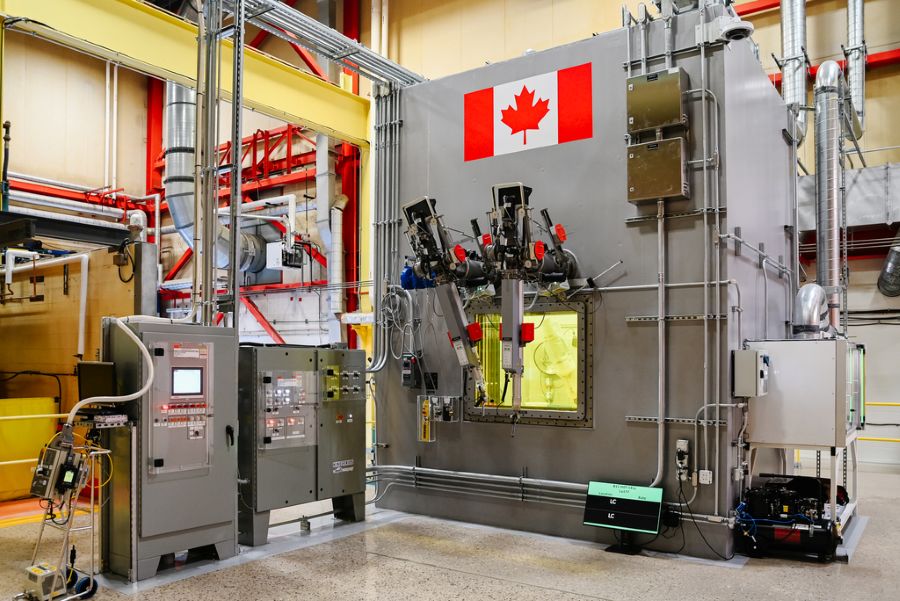
Bruce Power’s hot cell for the TCR step of lutetium-177 production, in Tiverton, Ontario. (Photo: Bruce Power)
The Canadian Nuclear Safety Commission has given Bruce Power approval to operate the company’s hot cell facility in Tiverton, Ontario, for medical radioisotope processing. This approval allows the facility to conduct Target Carrier Removal (TCR), a key step in the production of lutetium-177, an isotope used to treat prostate and gastric cancers.
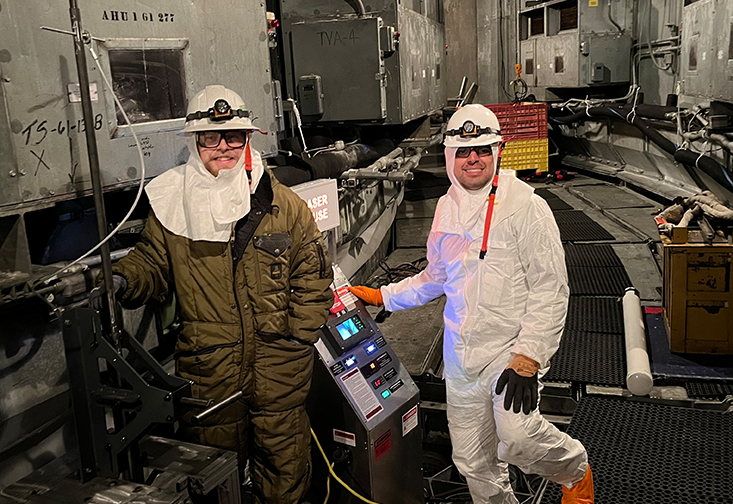
Ty Hagan, left, and Ahmad Vaselbehagh of the University of South Florida are seen during the testing of their laser-based maintenance technology inside a TVA nuclear power plant. (Photo: University of South Florida)
The Tennessee Valley Authority has successfully tested a new laser-based maintenance technology developed by engineers at the University of South Florida. The technology involves the use of a precision laser during regular inspections of ice condenser systems that are part of the emergency core cooling systems at certain nuclear power plants.
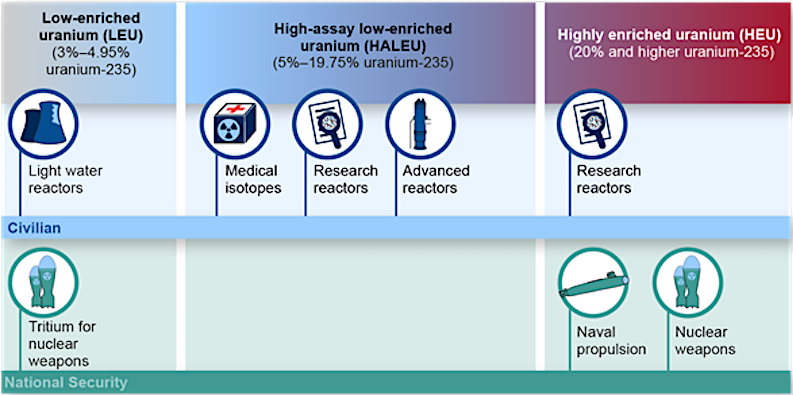
A graphic from the GAO report highlights the various uses of nuclear fuel for commercial and national security purposes. (Image: GAO)
The Government Accountability Office has released a report to Congress titled “Nuclear Fuel: Actions Needed to Enhance Cost Reporting and Economic Analysis for Federal Uranium Supply Efforts.” The report describes National Nuclear Security Administration estimates of enriched uranium supplies and demands, examines the NNSA’s plans to meet enriched uranium needs, and describes potential challenges to meeting supply goals. It also examines Department of Energy efforts to support the front-end fuel cycle for the commercial nuclear industry.
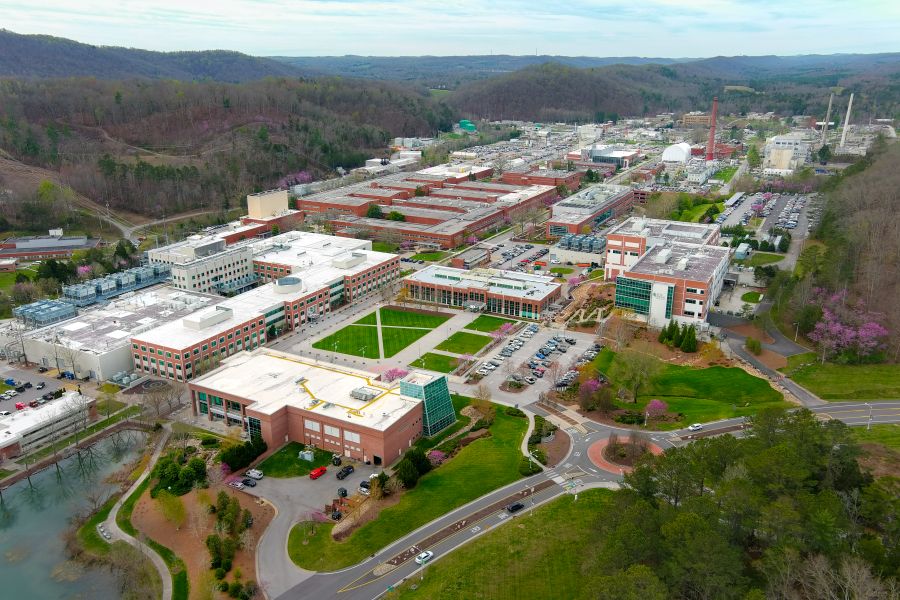
An aerial view of ORNL's East and Central Campus. The Oak Ridge, Tenn., area could host Nuclear Lifecycle Innovation Campus functions. (Photo: ORNL)
In January, the Department of Energy announced its new Nuclear Lifecycle Innovation Campus (NLIC) program, inviting states via a request for information to express their interest in hosting a facility supporting work from the front to the back end of the nuclear fuel cycle.
By April, 26 states had expressed interest in hosting such a facility. At the end of July, the DOE signed memorandums of understanding with five states—Idaho, Louisiana, Oklahoma, Tennessee, and Utah—to more closely explore the possibilities of state-federal partnerships. These MOUs are not firm commitments from either the federal or state governments. Time will tell which—if any—of the five states develop projects through the program. In the meantime, today, we are taking a close look at what Utah, Idaho, Tennessee can offer in terms of a preexisting nuclear sector that could support new fuel cycle developments.
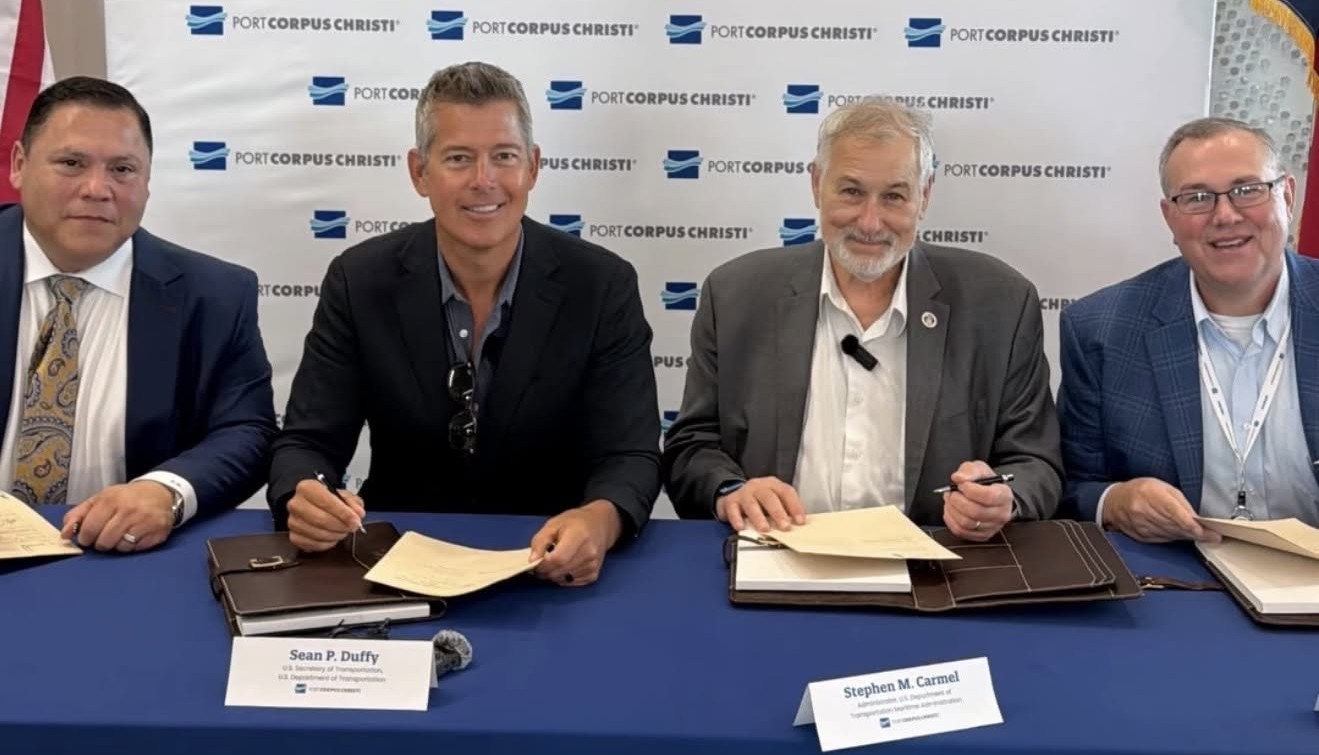
Federal and port officials sign an MOC to explore maritime nuclear opportunities in the Port of Corpus Christi in Texas. (Photo: MARAD)
The Department of Transportation’s Maritime Administration (MARAD) has signed its second memorandum of cooperation with a U.S. seaport to advance the development of small modular reactors to power commercial vessels, ports, and other maritime assets—this time, shifting its attention to the Gulf coast.
The MOC pairs the Port of Corpus Christi in Texas with MARAD to explore SMRs, microgrids, and advanced vessel propulsion systems for maritime applications. Last week, Secretary of Transportation Sean Duffy, MARAD Administrator Stephen Carmel, Port of Corpus Christi CEO Kent Britton, and Port of Corpus Christi Commission Chair Gabe Guerra signed the MOC at a ceremony.
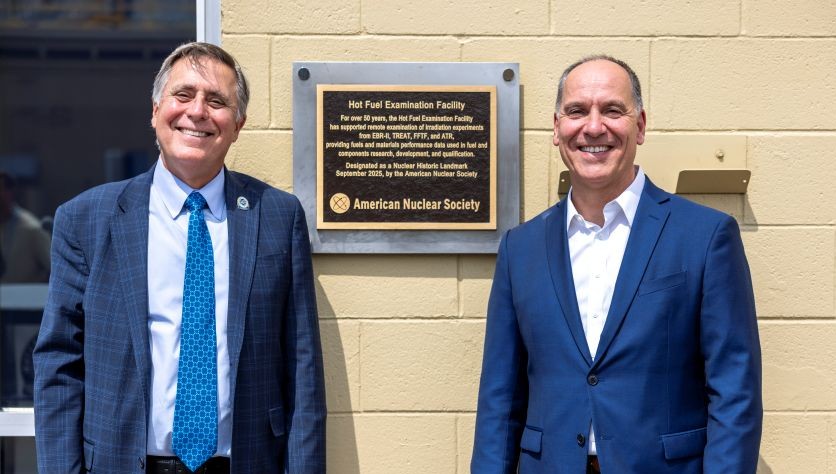
ANS President Mark Peters and INL Director John Wagner pose with the plaque officially designating HFEF a Nuclear Historic Landmark. (Photo: INL)
American Nuclear Society President Mark Peters visited Idaho National Laboratory on August 12 to unveil the plaque that officially designates the Hot Fuel Examination Facility (HFEF) a Nuclear Historic Landmark.
Landmark status was conferred on HFEF last October. It is INL’s 10th landmark on the list and one of 101 the Society has honored since 1985. ANS’s Nuclear Historic Landmark Award memorializes sites and facilities where outstanding physical accomplishments that advanced the peaceful uses of nuclear energy have taken place. The award recognizes facilities that were in service at least 20 years ago.
A dish prepared with fried cicadas. (Photo: Zhao Liu/iStock)
This week, the International Atomic Energy Agency announced a new coordinated research project (CRP) to improve understanding of the safety of edible insects and other novel foods and to use nuclear and related technologies to assess risks.
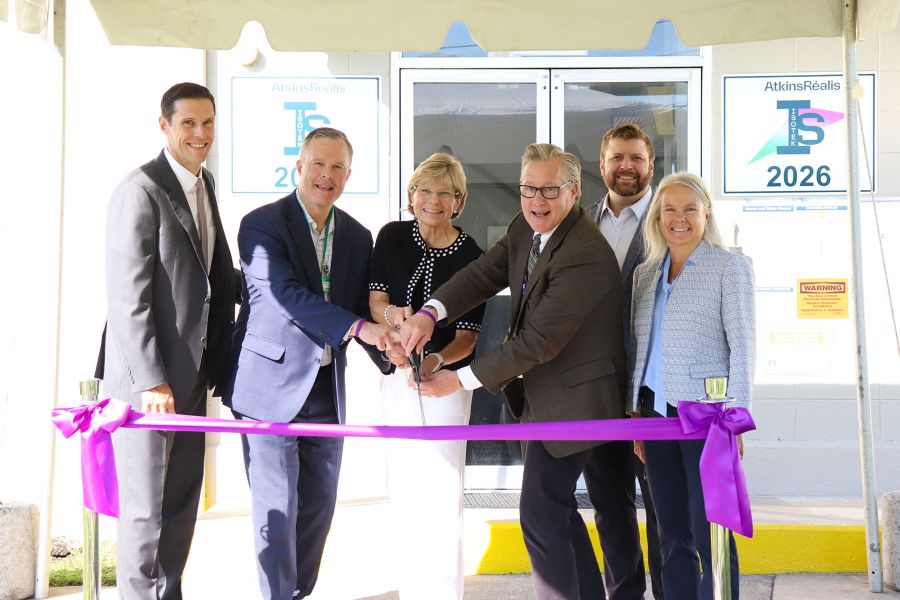
The ribbon is cut for the new analytical lab in ORNL’s Building 2026 by, from left, AtkinsRéalis’s Jeff Kendall, TerraPower Isotopes’ Scott Claunch, Isotek Systems’ Sarah Schaefer, OREM’s Erik Olds, TerraPower Isotopes’ Ben Goodrich, and OREM’s Teresa Robbins. (Photo: DOE Oak Ridge Office of Environmental Management)
A new analytical laboratory at Oak Ridge National Laboratory has been officially opened by the Department of Energy’s Oak Ridge Office of Environmental Management and its contractor Isotek Systems. The state-of-the-art lab, located in Building 2026, is being used to speed up the high-priority cleanup of ORNL’s uranium-233 inventory and accelerate the delivery of actinium-225 to facilities that use the radioisotope in research and for potential treatment of patients with cancer.
Rendering of Firefly’s Blue Ghost lunar lander with a closeup of Zeno Power’s Survive-the-Night package hosted on the top deck. (Image: Zeno Power/Firefly Aerospace)
As established by a commercial payload agreement, a radioisotope heating unit (RHU) developed by Zeno Power will be onboard one of Firefly Aerospace’s existing Blue Ghost missions to the near side of the moon as part of NASA’s Commercial Lunar Payload Services, the companies announced yesterday.
Zeno, which has already been working on an americium-241–fueled radioisotope power system for Harmonia RPS, will provide a lightweight, compact 5-Wt Am-241 RHU that includes communications, electrical power, command and data handling, and thermal management subsystems.
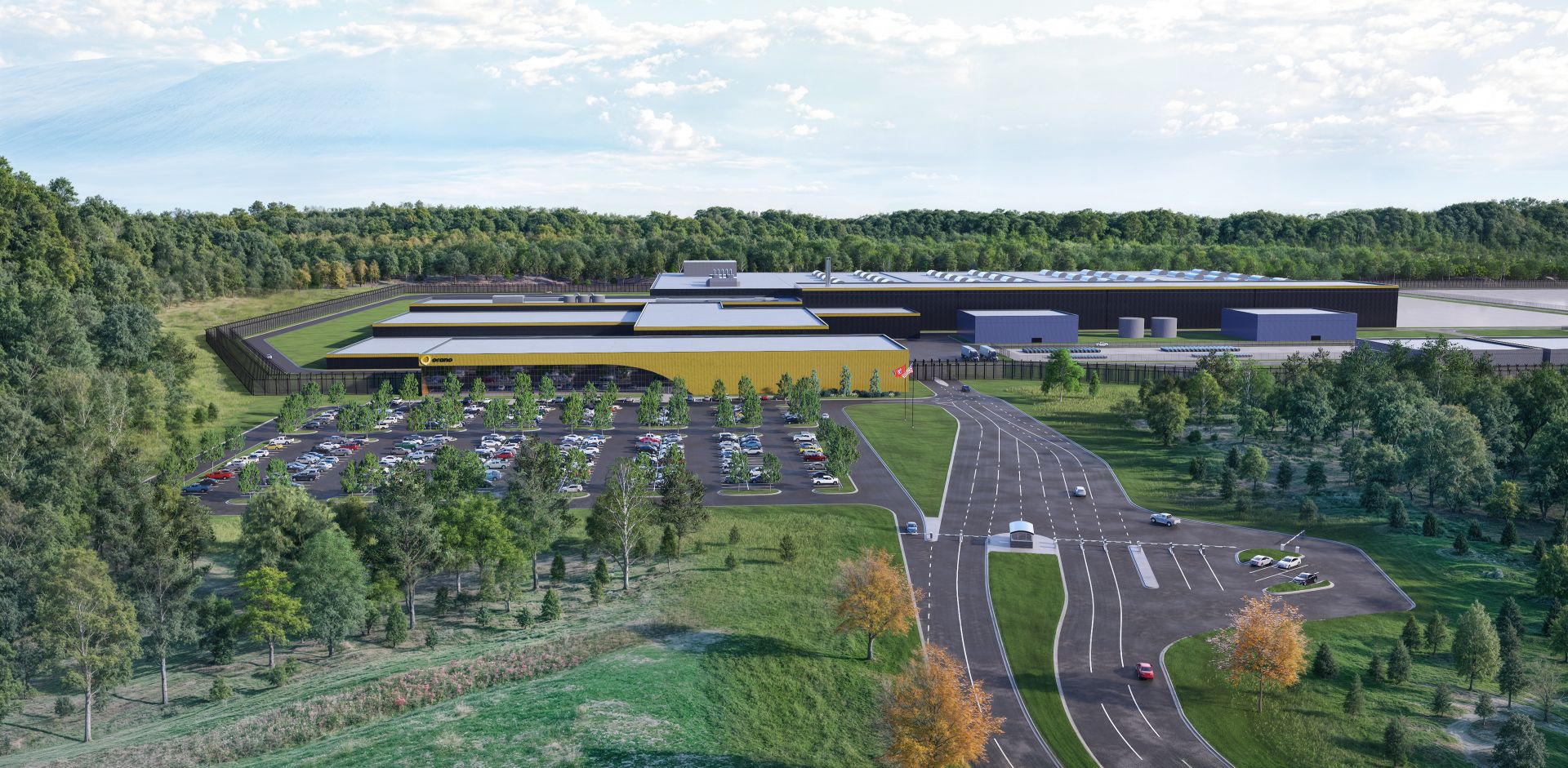
Concept art of Orano’s planned Project Ike facility in Oak Ridge, Tenn. (Image: Orano)
The Nuclear Regulatory Commission is considering Orano Enrichment USA’s application for a license to build a centrifuge enrichment facility in Oak Ridge, Tenn. A notice published in the Federal Register on August 12 includes a commission order and an announcement of the opportunity to request a contested hearing.
The publication of the FR notice marked the start of a 60-day period in which a member of the public can file a request for a hearing. If contentions are adjudicated, the NRC intends to not hold a second, uncontested hearing before issuing a license on the $5 billion Project Ike Enrichment Facility, where Orano plans to reenrich depleted uranium hexafluoride (UF6) tails and enrich natural-grade UF6 to a maximum of 8-weight percent uranium-235.
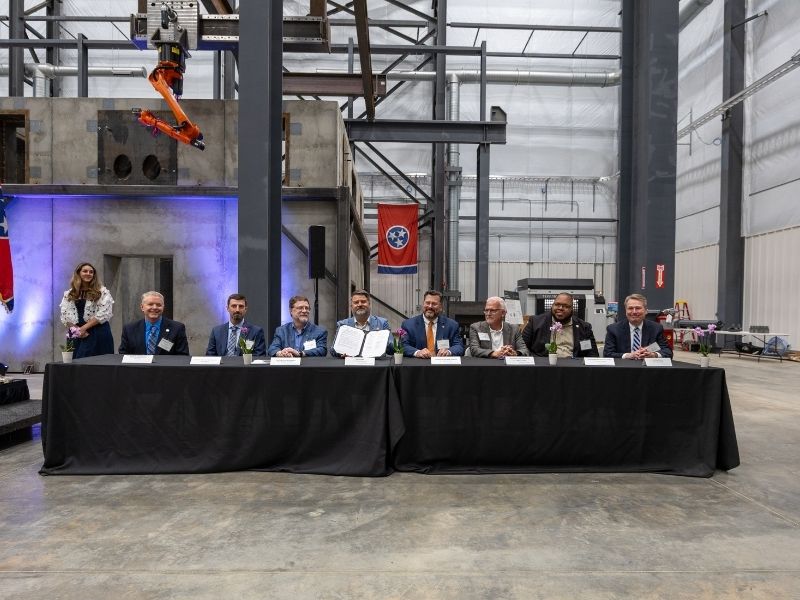
Kairos Power and others launch NuCAMP at the company's Oak Ridge, Tenn., campus. (Photo: Kairos Power)
As Kairos Power’s high-temperature, fluoride salt–cooled reactor facilities in Oak Ridge, Tenn., take shape, the company is partnering with multiple regional groups to prepare the local workforce for new nuclear career opportunities.
Kairos has signed a memorandum of understanding with Oak Ridge National Laboratory, the University of Tennessee–Knoxville, the Institute for Advanced Composites Manufacturing Innovation (IACMI), Barnard Construction, Roane State Community College, Chattanooga State Community College, and Oak Ridge Schools to form the Nuclear Center for Advanced Manufacturing and Precast, or NuCAMP.

 What fuels the future of nuclear? Whether it is low-enriched uranium, LEU+, or high-assay low-enriched uranium, one of the answers is in the question itself: fuel.